Judith
How to Change Your MindJudith is the narrator’s partner and companion during a psilocybin experience at the New England house where they once lived. Her experience moves from unease on a walk away from home to focused engagement with visual patterns on the living-room couch. That trajectory makes her more than a witness to the narrator’s afternoon: her different needs and perceptions shape its course, and later help confirm one of its most extraordinary sights.
Identity and Shared Context
Many months after finding the mushrooms with Paul Stamets, the narrator and Judith ate them together during a summer week at their former house. The place was freighted with memories: they had spent summers there as a couple and then as a family. The narrator prepared a tea by crumbling two small mushrooms into each of two glasses and pouring hot water over them, following Paul Stamets’s recommendation to cook the mushrooms to destroy compounds that could upset the stomach. Each drank half a cup, liquid and mushroom pieces alike. The narrator proposed a walk along the dirt road while they waited for the effects.
The account identifies Judith as a painter, a detail that becomes relevant not as a general explanation of her response but through her own particular attention to images. The afternoon also unfolds in a house and garden bound to the couple’s past, though Judith’s experience does not initially turn toward memory or landscape in the same way as the narrator’s. Her shifting relationship to the setting—first wanting to return home, then choosing the couch and its visual field—gives the shared experience a clear, separate line of action.
Distress on the Walk
After about twenty minutes, Judith reported that she was “feeling things,” and that none of them was pleasant. She no longer wanted to walk, but the pair were at least a mile from home. She described her mind and body as drifting apart, then said her mind had flown out of her head and up into the trees like a bird or insect. The account conveys the force of her disorientation through these successive descriptions, without suggesting that she welcomed or sought it.
Judith urgently wanted to get home and feel safe. The narrator turned back with her and quickened their pace. In the heat and heavy humidity, she also said, “I really don’t want to run into anybody.” The narrator tried to reassure her, while recognizing that remaining capable of acting normally might matter if a neighbor stopped to talk. Shortly before reaching the house, they saw a neighbor’s pickup truck coming toward them and ducked into the woods until it had passed. The episode makes Judith’s need for safety concrete: the possibility of an ordinary roadside encounter had become a source of alarm, and the pair’s return was interrupted by the very kind of contact she feared.
The Couch and the Images
At home, Judith went straight to the living-room couch and lay down with the shades drawn. The narrator, who did not yet feel much, finished the remainder of the tea in the kitchen. Judith’s mood lightened once she was settled on the couch, and she said she was fine. The change is modest but consequential: the account does not describe the discomfort simply disappearing, but records that she felt better in the place where she had asked to be.
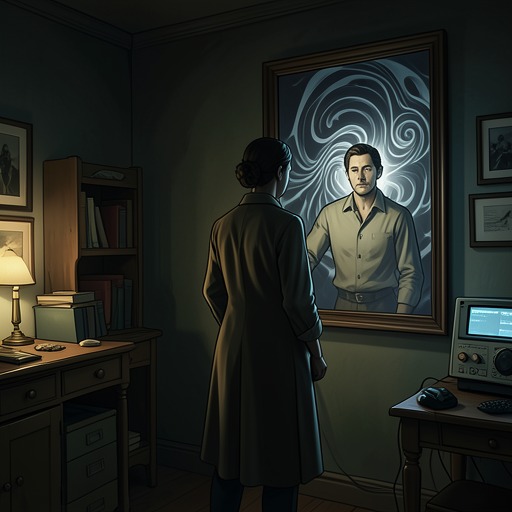
When the narrator checked on her before wandering farther from the house, Judith had a cool, damp cloth over her eyes. She was then having “these very interesting visuals”: stains on the coffee table seemed to come to life, swirl, transform, and rise from its surface. She found the images compelling and made clear that she wanted to be left alone to sink further into them. Because she was a painter, her absorption in the changing forms is especially salient, but the account keeps the focus on her expressed preference rather than assigning her an unspoken interpretation. The narrator thought of “parallel play,” a phrase that described how they would spend the rest of the afternoon: together in the same house, but attending to separate experiences.
A Distinct Place in the Afternoon
Judith’s response contrasts with the narrator’s movement outdoors. While the narrator became acutely attentive to the garden and to a sense of being implicated in its life, Judith chose privacy indoors and continued to explore the visuals on the coffee table. Neither response is presented as the definitive version of the afternoon. Their divergence instead shows how a shared experience could involve different needs, settings, and forms of attention; Judith’s request to be left alone is respected rather than treated as an obstacle to the narrator’s account.
Later, when the narrator returned toward the house at dusk, the garden seemed crowded with unusually numerous dragonflies. The narrator was not sure the sight was real and subsequently asked Judith to come outside; she confirmed what had been seen. This brief confirmation connects her indoor experience to the afternoon’s outdoor scene without erasing their difference. Judith’s role is both intimate and evidentiary: she shares the experience, establishes the importance of feeling safe and choosing where to be, and finally corroborates a perception that the narrator had doubted.